
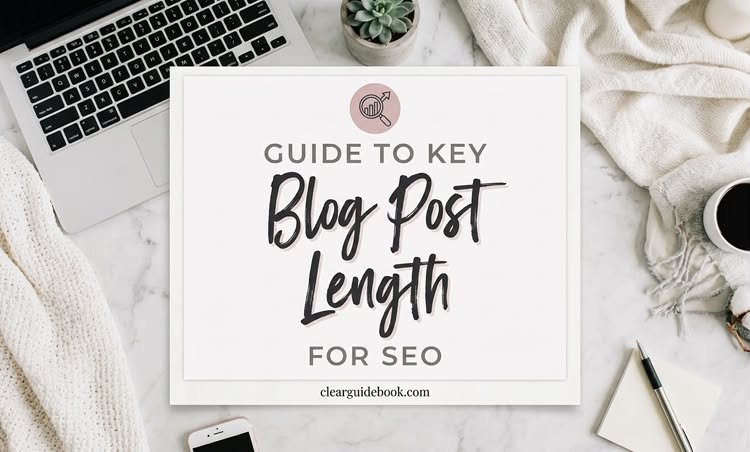
How Long Should a Blog Post Be for SEO? (The Honest Truth for Beginners)
If you ask different SEO people how long should a blog post be, you’ll probably get completely different answers. Some will tell you to write 3,000 words. Others will say 500–800 words is enough.
When I first started learning about blogging and SEO, I had the same question:
“How many words do I actually need to write if I want my blog post to rank on Google?”
The honest answer is: there is no magic word count.
You don’t need to force every article to 2,000 or 3,000 words just because someone on YouTube said so. What matters more is whether your article actually answers what the person searched for.

How Long Should a Blog Post Be?
It depends on the topic. A simple question might only need 700–1,000 useful words. A detailed guide might naturally need 1,500–2,500 words.
For example, if someone searches: “What shoes go with beige trousers?” You probably don’t need 3,000 words to answer that.
But if someone searches: “How to start a blog from scratch”
That’s a much bigger topic, so a longer article makes sense.
So instead of asking: “How many words does Google want?”
I think a better question is: “How much information does my reader actually need?” That’s the approach I try to follow now.
Does Longer Content Rank Better?
Not automatically. Writing more words doesn’t magically make an article better. You can write 3,000 words and still have a weak article if half of those words are just repeating the same thing.
On the other hand, a 900-word article can be genuinely useful if it completely answers the search query. That’s why I wouldn’t add extra paragraphs just to hit a certain number.
If I’ve answered the question properly, I’d rather stop there than add unnecessary fluff.
Why Do Some SEO Articles Become Very Long?
There is a simple reason. Some topics have a lot of things to explain. For example, a complete guide about starting a blog might need sections about choosing a niche, setting up a website, writing content, basic SEO, internal links, and getting traffic.
In that case, a longer article makes sense because the topic itself is bigger. It’s not long because Google requires 2,000 words. It’s long because the reader needs more information.
What About Long-Tail Keywords?
This is one reason I personally like writing useful, detailed content. When you properly cover a topic, you can naturally answer related questions that people search for.
For example, instead of only targeting: “blog post length”
an article might naturally cover:
- how long should a blog post be
- ideal blog post length for SEO
- how many words should a blog post have
- SEO blog post word count
- how long should a blog post be for Google
I wouldn’t try to force all of these into the article. I’d simply cover the questions where they naturally fit.
My Simple Word Count Rule
I don’t follow a strict word count anymore.
Instead, I use this simple rule: Write enough to properly answer the topic — then stop.
As a rough starting point, you might find something like this useful:
- 500–800 words: Simple questions and quick answers
- 800–1,500 words: Most beginner-friendly blog posts
- 1,500+ words: Detailed guides where the topic genuinely needs more explanation
But these are not SEO rules. They’re just rough starting points. If a topic is completely answered in 900 words, I don’t think I need to turn it into 2,000 words.
And if a topic genuinely needs 2,500 words, I wouldn’t cut it down just to stay under some imaginary limit.
Related :
How Many Blog Posts Do You Need Before Getting Traffic from Google?
How Long Does It Take for a New Blog to Get Traffic from google?
How to Build Topical Authority on a New Website: A Practical Beginner’s Guide
What I Do Before Publishing
Before I publish a post, I usually ask myself a few simple questions:
- Did I answer the main question?
- Did I cover the important parts of the topic?
- Is anything repetitive or unnecessary?
- Can a beginner actually understand this?
And most importantly:
Would I find this article useful if I had searched for it myself?
If the answer is yes, I’m much more comfortable publishing it.
Don’t Write for a Word Count
This is probably the biggest thing I want beginners to take away from this post.
Don’t sit there thinking:
“I only have 1,100 words. I need another 900.” That’s how articles become full of fluff. Instead, look for things that genuinely improve the article.
Maybe you need another example.
Maybe you need to explain a confusing step.
Maybe you need a helpful FAQ.
Maybe you need to answer a related question.
If none of those are necessary, you don’t need another 900 words.

Final Thoughts
So, how long should a blog post be for SEO?
Honestly, as long as it needs to be useful. There isn’t one perfect word count that works for every topic or every website. A short article can be good. A long article can be good too.
What matters is whether you’re actually helping the person who searched for that topic.
That’s the mindset I’m trying to follow with my own blog too: less focus on hitting a number, more focus on making the article genuinely useful. And if you’re a beginner like me, don’t stress too much about whether your post is 1,000, 1,500, or 2,000 words. Write what the topic needs. Remove the fluff. Then publish.
Thanks for reading, and good luck with your blog!





One Comment