
How Long Does It Take for a New Blog to Get Google Traffic? A Realistic SEO Timeline
You start a new blog. You publish your first article. Then you wait. You check Google Analytics. Nothing. You check Search Console. Maybe a few impressions.
Then you search your own keyword on Google 15 times to see if your article is there. Still nothing. If this sounds familiar, don’t panic. This is one of the most frustrating parts of starting a new blog.
A lot of beginners think that once Google indexes an article, traffic should immediately start coming in. Unfortunately, that’s not how it works.
Google first needs to discover your pages, crawl and process them, understand what they are about, and then decide when and where they should appear for different searches. Even after a page is indexed, that doesn’t mean it will automatically rank on the first page.
So, how long does it actually take for a new blog to get traffic from Google?
The honest answer is: there is no fixed number of days or months.
Some websites start getting impressions within a few weeks. Some begin getting meaningful clicks after several months. Others take longer, especially when they’re targeting competitive keywords.
The good news?
You don’t have to sit around for six months doing nothing. There are things you can do from day one that give your new blog a much better chance of growing.
Let’s break down what actually happens.
One little note before we start: I’ve gone into quite a bit of detail here because there’s no point telling you “wait 6 months” and leaving you confused about what you’re actually supposed to do during those months.
So don’t feel like you have to finish the whole thing today. I’ve broken everything into sections, so you can read a little now, save the article, and come back whenever you have time. Even if you only read one or two sections today, you’ll still find something useful.
How Long Does It Take for a New Blog to Get Google Traffic?
For most completely new blogs, I would think in terms of months, not days. That doesn’t mean your website will get zero traffic for the first six months.
You might see:
- Your pages getting indexed
- Search impressions appearing in Search Console
- A few clicks from very specific searches
- Articles appearing on page 5, page 3, or page 2
- Some random keywords you didn’t even intentionally target
- Gradual increases in impressions as more pages get indexed
And then, sometimes, one article starts moving. That article can bring a few clicks. Then more. Then another article starts getting impressions.
Eventually, several pages can begin bringing traffic at the same time.
That’s the part beginners often don’t see when they look at their brand-new blog after two weeks and think, “This isn’t working.”
A realistic way to think about the first year
There is no official Google timetable like “three months = 100 visitors.”
Instead, think about the stages:
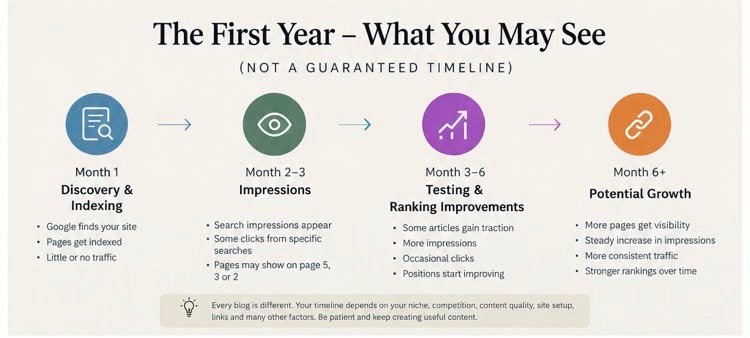
But these are rough stages, not promises.
A new blog can move faster or slower depending on the niche, competition, content quality, search demand, site setup, links, and many other factors.
That’s why I wouldn’t judge a new blog just because it has low traffic during its first few months.
Does Google Have a 6-Month Sandbox?
You’ve probably heard this everywhere:
“Google puts every new website in a six-month sandbox.”
It sounds convincing. But there’s an important problem with that statement.
There is no official Google rule saying that every new website must wait six months before receiving Google traffic.
People in the SEO community often use the word “sandbox” to describe the slower performance many new websites experience. And honestly, the experience can feel like a sandbox.
You publish good articles. You do everything correctly.
And still…
Google traffic barely moves. But that doesn’t mean Google has a secret six-month timer running on your domain. There are many reasons a new website can take time to gain visibility.
For example, you’re competing against websites that already have established content, links, brand recognition, and years of search history.
Your article might also simply not be the strongest result for the query yet.
So instead of thinking:
“I have to survive Google’s six-month sandbox.”
Think:
“My website is new, and Google needs time to understand and evaluate my content.”
That’s a much more useful way to look at it.
Indexing Is Not the Same as Ranking
This is another thing that confuses new bloggers. You submit your article. A few days later, you search:
site:yourwebsite.com/your-article
And there it is. You celebrate. “My article is indexed!” Great. But then you check your target keyword. Your article is nowhere to be found.
What happened? Nothing went wrong. Being indexed and ranking are two different things. Indexing basically means Google has added the page to its searchable database. Ranking is about where that page appears when someone searches for something.
Your article can be:
Indexed + ranking at position 87
or
Indexed + ranking at position 23
or
Indexed + ranking at position 6
All three mean your page is indexed. But only the last one is likely to bring significant organic traffic.
This is why you shouldn’t panic just because an indexed article isn’t immediately bringing visitors.
What Happens Before Google Traffic Starts Growing?
There are several things happening behind the scenes.
1. Google discovers your page
Google needs to find your URL.
This can happen through links, your sitemap, or other ways Google discovers URLs.
2. Google crawls the page
Googlebot accesses the page and processes its content.
3. Google indexes the page
If Google decides the page is suitable for indexing, it can become eligible to appear in Search.
4. Google tries to understand the page
Google needs to understand what your article is about and which searches it may be relevant for.
5. Your page competes with other results
This is where things get interesting. There may already be dozens, hundreds, or thousands of pages covering a similar topic.
Your page isn’t automatically going to beat them just because it is new or because you used the keyword in your title.
6. Your page may start receiving impressions
You might appear for searches without getting many clicks.
For example, your article could receive:
300 impressions + 5 clicks
That’s not exciting compared with thousands of visitors, but for a very new website, it is still useful information.
It tells you that Google is showing your page for some searches. And now you have something to work with.
Don’t Ignore Search Impressions
A lot of beginners only look at clicks. That’s a mistake.
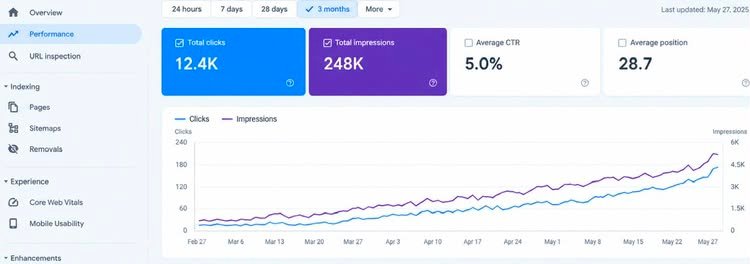
Imagine your article has:
1,000 impressions
15 clicks
You might think: “Only 15 visitors. Terrible.” But I’d look at it differently. Your page is already appearing in Google.
Now you can investigate:
- Which queries triggered those impressions?
- What position are you appearing at?
- Are people seeing your title but not clicking?
- Are you ranking for keywords you didn’t expect?
- Can you improve the article to better answer those queries?
This is where Google Search Console becomes extremely useful.
Google describes Search Console as a tool that helps website owners monitor their performance in Google Search and understand how Google sees their site.
My Biggest Beginner Mistake: Going Too Broad
One of the easiest ways to make a new blog painfully slow is to attack huge keywords immediately. Imagine you’ve just started a fashion blog.
You see these keywords: “fashion, women’s dresses, old money outfits, best handbags” They look attractive because lots of people search for them. So you write an article around one.
Six hours later, you publish it. Then you wait. Nothing happens. The problem isn’t necessarily that your article is bad. The problem may be competition and search intent.
Established websites are already competing for those broad searches. A new website usually has a much easier starting point when it finds narrower topics that still have real search intent.
For example:
Instead of: Old money outfits
You might target something more specific such as: old money outfits for women over 50
or:
old money casual outfits for summer
or:
old money work outfits for women
The exact keyword still needs research. You shouldn’t assume a long phrase automatically has low competition.
But the principle is useful: start specific. Build depth. Expand later.
Are Long-Tail Keywords Really Better for New Blogs?
They can be. But let’s kill another SEO myth:
Long-tail doesn’t mean zero competition. A long-tail keyword is simply a more specific search query.
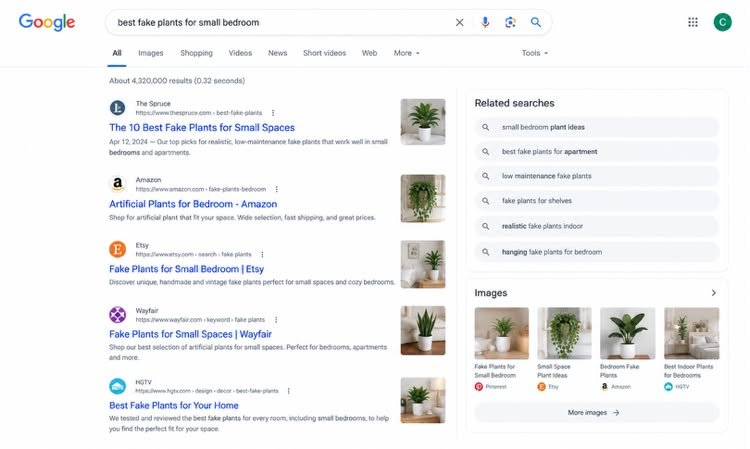
For example: “plants” is extremely broad. “best fake plants for small bedroom corners” is much more specific. The second query tells you far more about what the person wants.
That is valuable because you can create a page that answers that exact need.
Before targeting a keyword, search it yourself. Look at the pages already ranking, the type of content Google is showing, and whether your article could genuinel ovide something useful that those results don’t.
Why I like long-tail keywords for beginners
- They help you answer a very specific question.
- They make it easier to understand search intent.
- They can reduce the number of directly competing pages.
- They can give smaller websites opportunities to build topical relevance.
- And they can bring visitors who already know what they’re looking for.
But don’t fall into the trap of thinking:
“I found a 7-word keyword, therefore I’ll rank.”
SEO doesn’t work that simply. You still need useful content.
The Best Strategy: Don’t Just Chase Keywords
This is where many beginner blogs go wrong. They find a keyword. Then they write 1,000 words around that keyword. Then they repeat the keyword 25 times. That’s not a strategy.
Instead, ask:
“What does someone actually want when they search this?”
Let’s say the search is:
how to style fake plants in bedroom
The reader probably wants:
- actual styling ideas
- bedroom examples
- small-space ideas
- nightstand ideas
- corner ideas
- planter suggestions
- realistic-looking faux plant tips
- answers to common questions
So your article should cover those things. That’s much better than writing 1,500 words that basically say: “Fake plants are beautiful.” over and over again.
How Many Blog Posts Should You Publish?
You’ll often hear:
“Publish 50 posts.”
Or:
“Publish 100 posts.”
Or:
“Post every single day.”
There isn’t a magic number.
I’d rather have 30 genuinely useful articles than 100 thin articles created just to hit a number.
Your goal should be to build a useful collection of pages around your niche.
For example, if you’re building a home decor blog, don’t publish:
- 10 nearly identical artificial plant articles
- 15 generic “home decor ideas” articles
- 20 posts rewritten from competitors
Instead, cover different problems and different search intents.
That gives Google more useful content to understand and gives your readers more reasons to visit another page on your site.
Internal Linking Is More Important Than Beginners Think
Let’s say you publish this article: How to Style Fake Plants in Bedroom
Later, you publish: Best Faux Plants for Small Apartments
Those articles are related. Link them together naturally. Then you publish: How to Decorate a Bedroom on a Budget You can potentially connect that article too.
You’re basically creating a small network of useful information.
Don’t force links everywhere.
Just link when another article genuinely helps the reader.
Google’s documentation also recommends making important pages discoverable through links, and Search Console can help you monitor how pages are appearing and being processed.
What About Backlinks?
Backlinks can help. But don’t become obsessed with them during your first week. A lot of beginners spend more time trying to get backlinks than actually improving their website.
First make sure your site is worth linking to. Create content that answers questions properly.
- Make useful guides.
- Add original examples.
- Use your own experience when you genuinely have it.
Then, as your site grows, you can work on legitimate ways of getting other websites to reference your content.
And please don’t buy hundreds of random backlinks from some guy promising:
“10,000 high authority backlinks for $5.”
That’s not the shortcut you want. Google has spam policies specifically covering manipulative practices and content created primarily to manipulate rankings.
What Should You Do During Your First 3 Months?
If I were starting a brand-new blog today, I wouldn’t spend the entire first month staring at Analytics. I’d build the foundation.
Month 1: Get the basics right
Set up:
- Your domain
- A clean website structure
- About page
- Contact page
- Privacy policy
- Clear navigation
- Search Console
- Sitemap
- Analytics if you want detailed traffic data
Then start publishing useful content. Don’t wait until everything looks perfect.
Month 2: Build your content base
Look for specific topics your audience actually searches for. Create content around different but related problems. Start internally linking relevant articles. Look at Search Console to see whether Google is discovering your pages.
Month 3: Start looking for patterns
Now your Search Console data becomes more interesting. You may find that an article is appearing for queries you never specifically targeted. That’s valuable.
Maybe your article is ranking for a related phrase at position 18. Instead of immediately writing another random article, look at that existing page.
Could you make it more useful?
Does it actually answer the query?
Are important subtopics missing?
Could the title better explain what the page offers?
This is where blogging becomes less about guessing and more about using actual data.
What If You Have Almost No Traffic After 3 Months?
First:
Don’t automatically assume your website is dead. Three months is not a universal deadline. Instead, check the basics.
Is Google indexing your pages?
Use Search Console. If important pages aren’t being indexed, investigate why.
Are you getting impressions?
If yes, that’s different from getting absolutely nothing. Impressions mean your pages are appearing for searches. Now you need to work on relevance, content, rankings, and click-through rate.
Are you targeting extremely competitive keywords?
If your entire website is targeting giant keywords, your strategy may need changing.
Are your articles actually useful?
Be honest here.
Would you choose your article over the other results on Google?
If not, improve it.
Are your articles too similar?
If you have 15 posts that basically answer the same question with different titles, you may not be building much additional value.
Are you publishing consistently?
You don’t need to publish every day. But disappearing for months while expecting your site to grow isn’t a great strategy either.
What If You Still Have Almost No Google Traffic After 6 Months?
This is where I’d stop saying: “Just wait.” Instead, diagnose the website. Look at your Search Console data.
Find your pages that have:
Impressions but very few clicks Those pages may need better titles and search-result presentation.
Then find pages with: Impressions but rankings around page 2 or 3. Those can be interesting opportunities. Improve the content. Make the answer more complete. Add useful internal links.
Make sure the article actually satisfies the search intent.
Then look at pages with: Almost no impressions at all. Those may need a deeper investigation. Maybe the topic has very little search demand. Maybe the keyword is extremely competitive. Maybe Google doesn’t see your page as a strong result for the intended query. Maybe the page isn’t being indexed properly.
This is much more useful than simply publishing another 50 articles and hoping something magically happens.
Can Pinterest Bring Traffic While Google Is Growing?
Absolutely.
And this is one reason I don’t think bloggers should depend on Google alone. SEO can take time.
Pinterest can sometimes send visitors to your content much earlier, especially when your content is naturally visual.
This can work particularly well for:
- Fashion
- Home decor
- Recipes
- Travel
- DIY
- Beauty
- Hairstyles
- Wedding ideas
- Interior design
- Plant decor
For example, you could publish:
30 Small Bedroom Decor Ideas
Then create several Pinterest graphics around different angles of the same article.
One pin could focus on:
Small Bedroom Ideas
Another:
Cozy Bedroom Decor
Another:
Small Bedroom Ideas on a Budget
You’re not changing the article into three different articles. You’re simply presenting the same useful content to people who may search for it differently on Pinterest.
Just remember: Pinterest traffic and Google traffic are different traffic sources. Don’t assume success on one automatically means success on the other.
Related: How to Write Pinterest Descriptions for SEO in 2026
Should You Use AI to Write Blog Posts?
AI can help you brainstorm.
- It can help with outlines.
- It can help you find questions to cover.
- It can help you rewrite awkward sentences.
But don’t build a website by taking AI-generated paragraphs, changing a few words, and publishing them at scale.
Google’s spam documentation specifically warns against automatically generated or republished content that exists mainly to manipulate search rankings, especially where it provides little or no original value.
The real question isn’t:
“Did AI help me write this?”
The better question is:
“Did I create something genuinely useful for the person searching?”
- Add your own experience.
- Add examples.
- Add observations.
- Add original images when possible.
- Mention mistakes you’ve actually made.
- Explain things in a way you would explain them to a friend.
That’s how an article stops feeling like a generic SEO page.
One Simple SEO Rule I Wish More Beginners Followed
Before publishing an article, ask yourself:
“If Google disappeared tomorrow, would this article still be useful to a human?” If the answer is yes, you’re probably thinking in the right direction.
If the article exists only because: “This keyword has 1,000 searches and I need an article for it.” then you may be approaching blogging backwards.
Keywords matter. Search volume matters. Competition matters. But the person searching matters too.
A Simple New-Blog Traffic Plan
If you want something practical, here’s the process I’d follow.
Step 1: Choose a focused niche
Don’t try to write about everything.
Step 2: Find specific topics
Look for questions and problems your audience actually searches.
Step 3: Check the existing Google results
Don’t only look at keyword volume. Search the phrase. See what type of pages Google is already showing.
Step 4: Create a better answer
Don’t just make your article longer. Make it more useful.
Step 5: Link related articles
Help readers move naturally from one useful page to another.
Step 6: Submit your sitemap and monitor Search Console
Use Search Console to understand indexing and search performance.
Step 7: Watch impressions, not just clicks
Early impressions can show you where your content is beginning to appear.
Step 8: Improve existing articles
If an article is already getting impressions, don’t automatically abandon it. Sometimes a good update can be more valuable than publishing another random post.
Step 9: Keep publishing
SEO isn’t something you “finish.” Your website should keep becoming more useful.
Step 10: Be patient, but don’t be passive
This is probably the biggest lesson. Patience doesn’t mean doing nothing. It means you keep improving the site without expecting overnight results.
Frequently Asked Questions
How long does it take for a new blog to rank on Google?
There is no fixed timeline. Some pages can start appearing in Search relatively quickly, while others may take months to gain meaningful visibility. Competition, content quality, search demand, site setup, and many other factors can affect the process.
How long does it take for a new blog to get traffic?
A new blog can receive impressions and occasional clicks relatively early, but consistent organic traffic often takes longer to build. Think in terms of months rather than expecting a guaranteed result after a specific number of days.
Does Google take 6 months to rank a new website?
No fixed six-month Google rule applies to every new website. The commonly discussed “Google sandbox” is an SEO community term, not a published Google timetable.
Can a new website rank on Google in the first month?
Yes, it is possible for individual pages on a new website to appear in Google Search within the first month. However, that doesn’t mean every new website will rank quickly or receive significant traffic.
How many blog posts do I need before getting traffic?
There is no magic number. A website with fewer high-quality, useful articles can outperform a website with hundreds of weak pages. Focus on covering relevant topics thoroughly instead of chasing a specific post count.
Are long-tail keywords easier to rank for?
They can be easier in some cases because they are more specific and may have fewer directly competing pages. But long-tail keywords can still be competitive, so always check the actual search results before deciding.
Should I wait six months before expecting Google traffic?
No. You should start monitoring your site from the beginning. Set up Search Console, check indexing, watch impressions and clicks, and improve your content as you collect data.
Why is my article indexed but getting no traffic?
Indexing only means Google has included the page in its index. Your page may still rank too low for meaningful traffic, target a competitive query, have weak search intent alignment, or simply be competing against stronger results.
Can Pinterest help a new blog?
Yes. Pinterest can provide another source of visitors while your Google visibility is developing, particularly for visually driven niches such as fashion, home decor, recipes, travel, and DIY.
Should I update old blog posts?
Yes, when the update genuinely improves the page. Look at your Search Console data and identify pages that already receive impressions or rank for related searches. Those pages can give you useful clues about what readers are looking for.
Final Thoughts: Don’t Give Up on Your Blog Too Early
Starting a blog is weird. At the beginning, you can spend hours writing an article that gets almost nobody to read it. It can feel like you’re talking to yourself.
You publish another post. Still quiet. Another one. Maybe a few impressions. And you start wondering whether Google simply doesn’t like your website. Don’t make that conclusion too quickly.
A new blog doesn’t have the same history, content depth, links, or search visibility as a website that’s been publishing useful content for years.
So yes, Google traffic can take time.
But the answer isn’t to sit around waiting for some imaginary six-month timer to finish. Use that time. Publish useful content. Target specific topics. Build related articles. Link them together. Watch Search Console.
Improve pages that are already getting impressions. Learn what your audience actually searches for. And most importantly, don’t confuse low traffic with no progress.
Your first 20 impressions might not look impressive. Your first click might feel almost meaningless. But those little signals can show you that your website is starting to enter the search ecosystem. Then one article might move. Then another.
And eventually, instead of checking whether you got your first visitor today, you may find yourself trying to figure out where all those visitors are coming from. That’s the part every new blogger is waiting for. And the best way to reach it isn’t to chase a magic number of months.
Build a website that deserves the traffic you’re hoping to get.